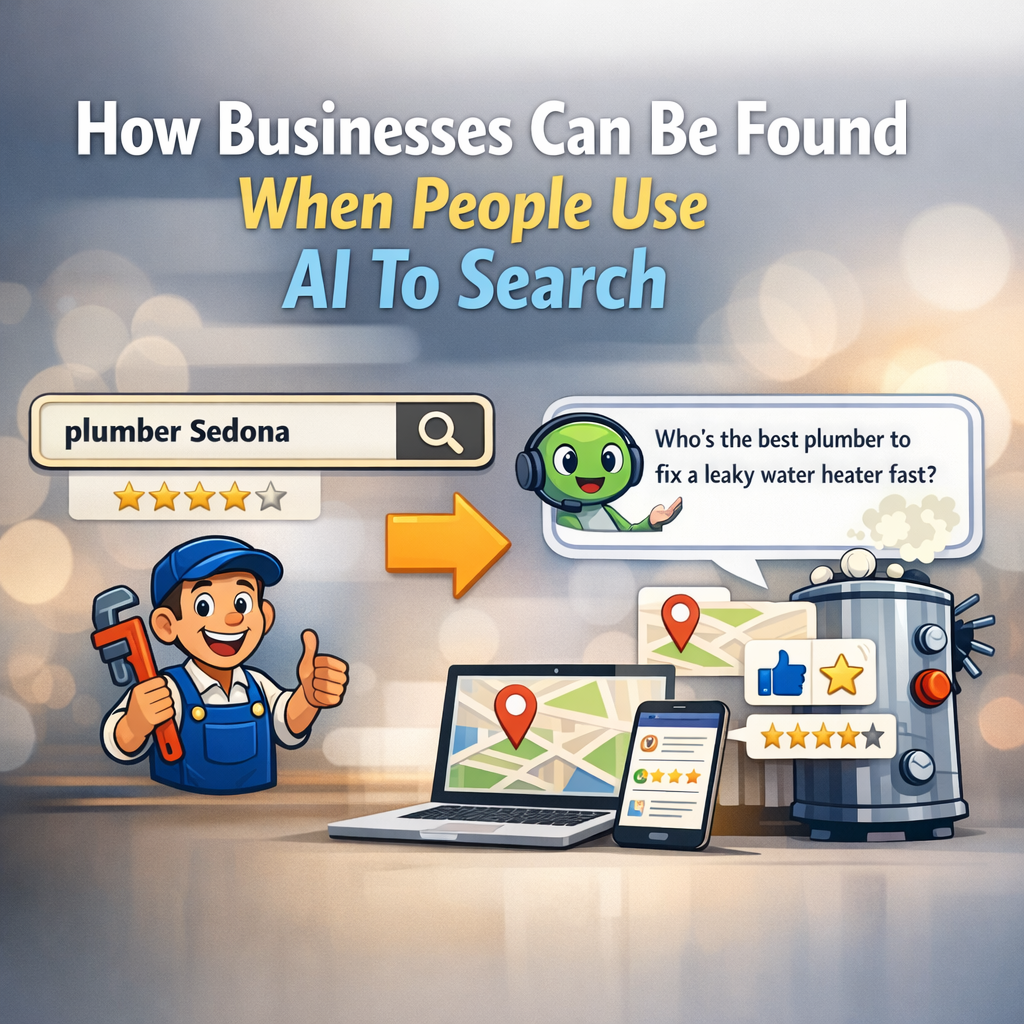
In the past year, artificial intelligence (AI) has rapidly transformed how people search for information online. Instead of typing short keywords into a search engine, users now ask full, conversational questions to AI tools like ChatGPT, Gemini, and Perplexity. This shift has major implications for small businesses — especially those in local markets like Sedona, Arizona — who rely on digital visibility to attract customers.
This blog post outlines how AI search behavior has changed, why it matters for small businesses, and what practical steps you can take to ensure your business is discoverable when people use AI to search.
How AI Search Behavior Has Changed
From Keywords to Conversations
Traditional search engines relied on keyword matching. A user might type “plumber Sedona” and get a list of websites. Today, AI tools interpret full questions like:
- “Who’s the most trusted plumber near me for emergency leaks?”
- “Which Sedona tour is best for families with young kids?”
- “Where can I get my water heater fixed today without breaking the bank?”
AI doesn’t just list websites — it summarizes, recommends, and filters based on trust signals, clarity, and relevance.
Rapid Adoption
According to recent data, over 54% of U.S. adults now use generative AI tools, up from 44.6% just one year ago. Non-work usage — including local recommendations — saw the fastest growth. This means AI is becoming the new front door to your business.
Why This Matters for Small Businesses
AI tools don’t “crawl” the web like traditional search engines. Instead, they extract structured information, analyze sentiment, and cross-reference multiple sources to make confident recommendations.
If your business isn’t clearly represented across the web — or if your information is outdated, inconsistent, or hard to understand — AI may skip you entirely.
How to Be Found in AI Search: 5 Key Strategies
1. Make Your Website AI-Readable
AI tools extract answers, not just keywords. Your website should be structured to make your services, location, and expertise easy to understand.
Checklist:
- Clear service pages (one service per page)
- Conversational FAQs that mirror how people ask questions
- Strong location signals (cities, neighborhoods, landmarks)
- Accurate hours, contact info, and pricing ranges
- Schema markup (your web developer can add this easily)
Tip: Avoid jargon. Use natural language that reflects how customers speak.
2. Build a Review Strategy That AI Trusts
AI heavily weights reputation. It summarizes sentiment and looks for patterns like “highly rated,” “trusted,” or “known for fast service.”
Checklist:
- Encourage a steady flow of new reviews
- Ask customers to mention specific services and outcomes
- Respond to every review — positive or negative
- Maintain consistency across Google, Yelp, Facebook, and industry platforms
Tip: AI tools read reviews deeply. Detailed, authentic feedback helps you stand out.
3. Be Everywhere AI Looks
AI cross-checks multiple sources to verify your legitimacy. The more consistent your presence, the more confident AI becomes in recommending you.
Checklist:
- Google Business Profile (fully updated)
- Yelp, Bing Places, Facebook, Instagram
- Industry directories (TripAdvisor, Angi, Houzz, etc.)
- Local chambers and business associations
- News articles or community features
Tip: Use the same business name, address, and phone number across all platforms.
4. Publish Helpful, Human Content
AI rewards businesses that demonstrate expertise. You don’t need long blog posts — just helpful content that answers real customer questions.
Content Ideas:
- “How to know if your tree needs trimming”
- “5 signs your AC is about to fail”
- “Best time of year to reseal your driveway in Arizona”
- “What to do before a ghost tour in Jerome”
Formats That Work:
- Blog posts
- Short videos
- FAQs
- Checklists
- Social posts
Tip: Focus on topics your customers already ask about. AI will match those questions to your content.
5. Optimize for Local AI Search
Local context matters. AI wants to recommend businesses that feel local, relevant, and active.
Checklist:
- Mention cities and neighborhoods you serve
- Reference local problems (monsoon season, wildfire prep, tourism cycles)
- Highlight seasonal relevance
- Showcase community involvement or partnerships
Tip: Use real local language. If your customers say “Uptown Sedona” or “Village of Oak Creek,” so should you.
Common Mistakes to Avoid
- Relying only on social media — AI needs structured website and directory signals
- Keyword stuffing — AI understands natural language, not spam
- Ignoring your Google Business Profile — it’s still the #1 local signal
- Letting your website go stale — AI deprioritizes outdated content
Final Thoughts: AI Is an Opportunity
AI search isn’t about gaming the system. It’s about being the most helpful, trustworthy, and clearly defined option in your category.
Businesses that win in AI search will be the ones who:
- Show expertise
- Build trust
- Stay consistent
- Answer real customer questions
- Keep their digital footprint clean and active
Call to Action
If you’re unsure how your business appears in AI search, now is the time to audit your online presence. At e‑Merge Online Marketing, we help businesses in Sedona and beyond optimize their digital footprint for today’s search landscape — including AI tools.
Contact us today to schedule a visibility audit and ensure your business is ready for the future of search.